We visited a secret Afghan girls school. They surprised us with handwritten “letters to the world.”
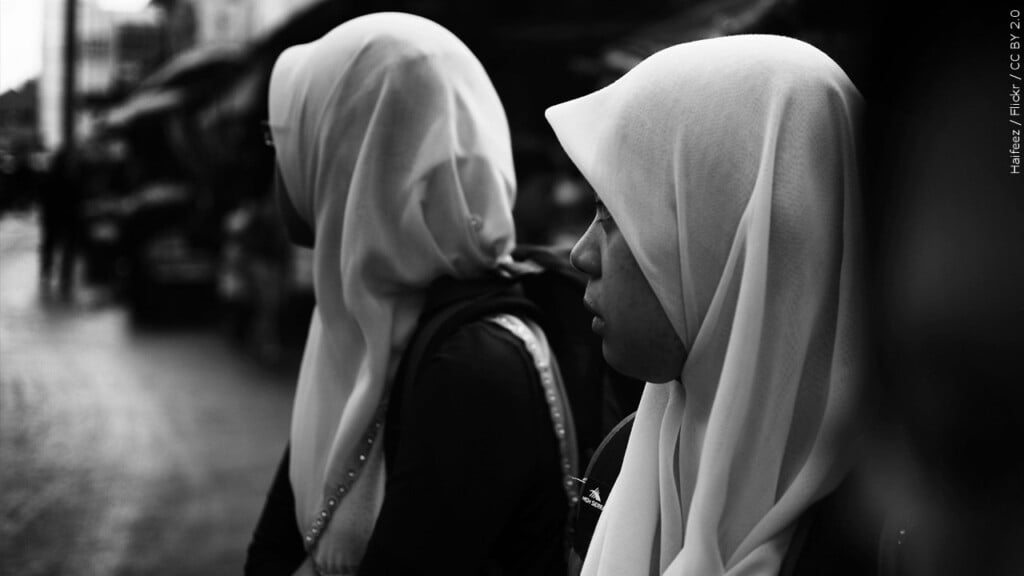
(CBS)– Kabul, Afghanistan – In a basement in a quiet corner of Kabul, CBS News was granted rare access this week to a secret school where teen girls dare to continue their education in defiance of a draconian Taliban regime — girls who want their voices to be heard.
The students, aged 14 to 16, surprised our team by asking us to share deeply personal messages each had written by hand, begging the world outside to help them escape conditions that have grown unfathomably worse in the five years since the Taliban retook power.
The students and their teachers are defying Afghanistan’s Taliban rulers, who, after taking back control of the country, banned formal education for all girls beyond the sixth grade.
CBS News has removed all references to their identities to protect the students and their teachers.
It’s hard to underscore the risk the girls take by coming to the underground school. Most dress as conservatively as possible, and they carry little more than pens and notepads with them to avoid suspicion. Some even tuck pieces of fabric into their bags, so if they are stopped by the Taliban’s feared morality police they can say they’re simply going to sewing lessons.I still have hope, even though every day brings another reason to lose it.
-Letter from a student at a secret Afghan girls school.But it is a risk they are all willing to take — including one 16-year-old who told CBS News she was “genuinely afraid” every time she made her way to the basement classroom.
“We are afraid of the Taliban,” she said. “They might arrest us.”
At the foreign ministry, Taliban spokesman Abdul Qahar Balkhi told CBS News that Afghanistan’s children “do have a basic fundamental right to education.”
“It’s a particular type of schooling system, educational system, and it’s suspended for now,” he said when pushed about the ban on girls attending school after the sixth grade, insisting that it “does not equate to taking away their fundamental rights to education.”
It’s an argument few can make any sense of, including the women and girls in the Kabul basement.
The underground school’s main teacher is a 25-year-old woman who was in her final year at university, earning an advanced science degree, when the Taliban barred women from higher education.
She said she runs the classes, “because I don’t want these girls to be uneducated and illiterate like women 20 years ago.”
“My mom used to always say to me, ‘I wasn’t able to study … so you must study,'” she recalled, breaking down in tears as she explained that her mother died last year. “She would always say to me … don’t give up … keep teaching these girls.”
At the end of the class CBS News got to sit in on, the teacher went around collecting pieces of paper from each girl.
They were not assignments. The students knew they would have foreign media visitors that day, and every one of them had written what they called a “letter to the world,” hoping CBS News would help share their voices.
I want being a girl not to mean that my dreams have to become smaller.
-Letter from a student at a secret Afghan girls school.
In the 21 heartfelt, handwritten letters, the girls poured out onto paper their hopes and dreams, which they cannot speak about freely in their country.
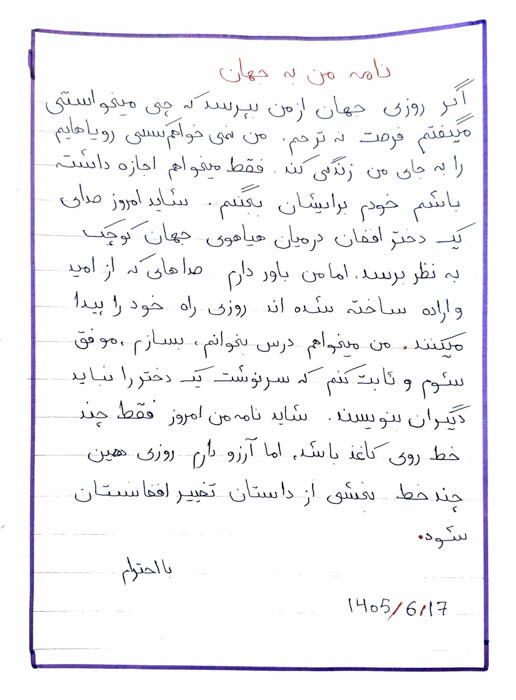
My Letter to the World
If the world ever asked me what I wanted, I would say: opportunity, not pity.
I do not want anyone else to live my dreams for me. I only want the chance to fight for them myself.
The voice of one Afghan girl may seem small amid all the noise of the world today, but I believe that voices born of hope and determination will one day find their way.
I want to study, to build, to succeed, and to prove that a girl’s destiny should not be written by others.
My letter may be only a few lines on a piece of paper today, but I dream that one day these very lines will become part of the story of change in Afghanistan.
With respect,
17/6/1405
8 September 2026
One of the students said she did not “want to tell you about my grand dreams. I want things that no one should ever have to dream of having. I want rights: the right to study, the right to work, the right to choose, and the right to build my own future. Is that really too much to ask?”
Her plea echoed those of her classmates — not for anything extraordinary, but for what many children in the U.S. and countless other places take for granted.
“I want being a girl not to mean that my dreams have to become smaller,” she wrote. “I want to do the work I love, to study where I choose, and to make my own decisions about my future.
World, I am asking you for an ordinary life — a life where having bread is not a dream, where work is not a matter of luck, and where safety and freedom are not fantasies.”
Just like her fellow defiant classmates and teachers, the young woman showed remarkable courage and resilience in the face of ever-tightening Taliban restrictions, concluding:
“I still have hope, even though every day brings another reason to lose it. I don’t want the circumstances I was born into to be all that life has to offer me. So hear me, world. If something is going to change, let it begin with what I am asking for.”
The basement school is part of the Invisibles Initiative, a network created after the Taliban closed secondary schools to girls in 2021, providing home-based classrooms for those shut out of formal education.
Its name captures the cruel reality of life for these students: They are forced to learn out of sight, always fearful the Taliban will find their secret schools. But through their letters, the girls are refusing to remain invisible, asking the world to see them, hear them and remember they are still here.
World, I ask you: do not see us merely as statistics on television. Behind every number is a girl. A girl with a name, a family, a heart and thousands of dreams.
-Letter from a student at a secret Afghan girls school.
Credits
Reporting by Imtiaz Tyab and Ahmad Mukhtar. Production by Sohel Uddin and Kamal Afzali. Design and development by Grace Manthey. Editing by Tucker Reals.