Rouzer’s absence from Cape Fear candidate forums draws criticism from opponents
WILMINGTON, NC (WWAY) — As early voting continues across North Carolina, U.S. Rep. David Rouzer faces criticism from opponents for missing several recent candidate forums in the Cape Fear region.
Rouzer, a Republican seeking his seventh term representing North Carolina’s 7th Congressional District, has missed several recent forums, raising questions about his accessibility to voters.
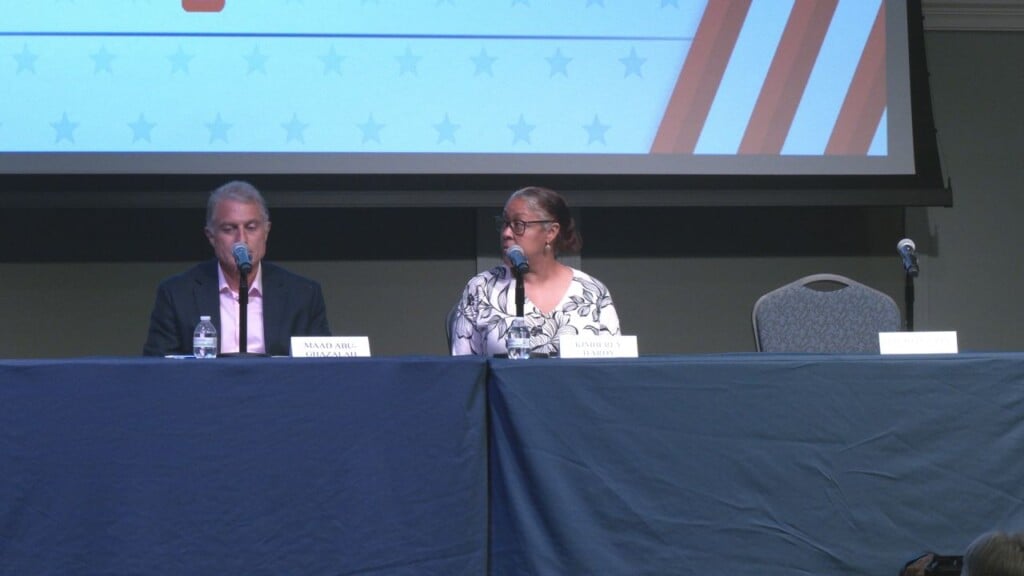
Libertarian candidate Maad Abu Ghazalah expressed frustration with the congressman’s absence.
“It makes me feel incredibly disrespected. It makes me feel invisible,” Abu Ghazalah said.
During a candidate forum at the University of North Carolina Wilmington last week, Abu Ghazalah took a moment to speak as if he were Rouzer.
“If I can just have a few moments to answer on behalf of David Rouzer. So my name is David Rouzer, I know many of you haven’t heard my voice before so this is what I sound like.”
Questions about Rouzer’s absence from public forums have persisted for years and intensified in recent weeks.
On Tuesday, a WWAY reporter saw Rouzer leaving a transportation summit in Brunswick County. His office told WWAY on Wednesday that the congressman has championed transportation improvements throughout his district.
WWAY has made multiple attempts to contact Rouzer’s office about his absence from candidate forums.
Following last week’s UNCW forum, WWAY called his Washington, D.C., office but received no response. A second call Wednesday reached a staff member who said the information would be passed along and a response would follow.
However, WWAY did not receive that promised response. An email sent to Rouzer’s communications director also went unanswered before publication.
Democratic challenger Kimberly Hardy said Rouzer’s absence is frustrating, particularly from the perspective of a constituent.
“I don’t really care how he sees me as a challenger as much as I care about how that looks and feels as a constituent. When you have someone who makes very intentional decisions to avoid hearing from you, to avoid having conversations and answering questions, then that really hits different as a constituent, and it tells you that you’re taken for granted.”
Rouzer has not held a town hall in the Cape Fear region since 2017.
Ben Schachtman with WHQR recalled attending that town hall, where he said Rouzer promised to remain accessible to constituents.
“He stuck around the whole time. He answered questions. Not everyone loved his answers, but he was certainly there to engage with the public. One thing that struck me was that he said, I think at least twice, you know, I’m going to be accessible. As long as I’m in office, I’ll be accessible. And then he never did one again.”
Despite their criticism, Hardy and Abu Ghazalah say they are focused on their own priorities for the district.
Hardy, a social work professor, wants to improve health care for veterans and expand access to medical services for residents.
“I know what military service looks like, what it’s supposed to mean, and that when we promise people the moon and the stars when they’re 17 and 18 to sign up.They shouldn’t have to go through so many hurdles in order to get access to that care. So you’re getting young people and retirees, and they all need access to healthcare. A single-payer healthcare system would help everybody across the board. And we can do that. We don’t have a lack of capacity. We just have a lack of will.”
Both challengers also raised concerns about plans to replace the Cape Fear Memorial Bridge, particularly the possibility of tolling to help pay for the project.
Abu Ghazalah questioned the proposed funding approach.
“We don’t want a toll bridge. And I think it’s, uh, it’s a trap. It’s like they, they put in this $200 million saying, oh, look, the federal government’s gonna pay for it, let’s get a new bridge. If you’re not willing to pay for this bridge, which people aren’t, then maybe we don’t need a bridge.”
Hardy also questioned whether the current proposal is financially feasible for the community.
“it was so clear that this whole option was the worst option. And so I kept saying, why don’t we do Plan C, which is go see if there’s something better that makes more sense, that doesn’t cost the taxpayers more money for this project, because if you cannot afford to cover the cost of this project without putting that financial burden on the backs of the members of this community, then this project is obviously not well conceived.”