Crews working California chemical leak in Orange County to conduct “all-night mission” to test tank pressure, officials say
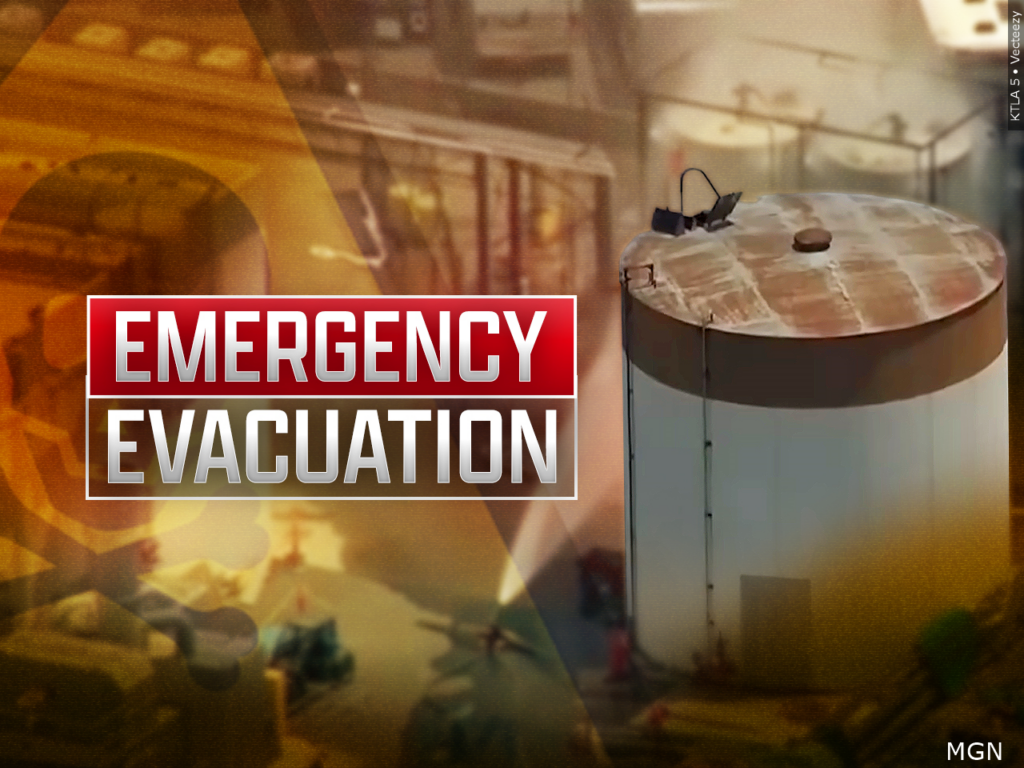
(CBS) — California firefighters will conduct an all-night operation to test the pressure inside a cracked tank at the center of a toxic chemical leak in Orange County, officials said Sunday, as more than 50,000 people remain under evacuation orders.
In an incident update posted on X, Orange County Fire Authority Interim Chief TJ McGovern said that crews would conduct the mission overnight to confirm that the “BLEVE threat,” or Boiling Liquid Expanding Vapor Explosion, was eliminated.
“The BLEVE threat is the worst-case catastrophic event that we’ve been talking about. We are not there yet; we need to run this operation tonight,” McGovern said.
He said that an update in the morning would reveal the results of the overnight tank inspection to determine if pressure was released or if there was a vapor buildup inside the tank.
In an earlier post, McGovern said that crews discovered a crack in the tank on Saturday night, which could be due to a pressure release. He said that it could alter the strategy as crews search for a solution to the crisis.
“With this new information, it could change our trajectory and our strategy to this event,” he said at the time. “Last night was a successful operation for this emerging incident.”
The Orange County Fire Authority told CBS LA on Sunday evening that multiple cracks existed in the tank. But in a post to X later that night, the agency qualified those reports, saying: “To clarify, there is one known crack on the tank. There is also peeling of weather stripping on the exterior, but this is not an additional crack.”
OCFA Public Information Officer Wayhowe Huang later clarified that the constant hose stream on the tank was causing the peeling away of the weather stripping, which could have caused confusion about the number of cracks in the tank.
The crisis, entering its fourth day on Sunday, remained without a clear solution as a tank estimated to contain 7,000 gallons of methyl methacrylate continued to leak at GKN Aerospace in Garden Grove. As of Saturday night, firefighters said that the internal temperature of the tank was over 100 degrees, more than double the “happy place” for the substance.
The news comes as California Gov. Gavin Newsom said he requested that President Trump issue an Emergency Declaration. The action would activate FEMA to direct federal assistance at the scene and allow federal funding to flow in.
“California doesn’t wait for disaster to unfold, we act early to protect lives and communities,” Newsom said. “Working together with our local and federal partners, we’re strengthening our ability to respond quickly and effectively in Garden Grove and across the surrounding communities and ensuring that first responders have the resources they need to keep people safe.”
The action differs from a Presidential Major Disaster Declaration in that it comes as a preemptive measure, rather than as a response to a disaster that’s already caused damage. It’s not yet clear if Mr. Trump will grant the request.
After Newsom’s request, Democratic U.S. Sens. Alex Padilla and Adam Schiff, and Orange County Rep. Derek Tran, co-signed a letter to Trump urging him to approve the state’s request for a Federal Emergency Declaration.
“The severity of this disaster requires additional coordination and federal support,” said part of the letter. “The safety, security, and well-being of evacuated residents and the surrounding communities remain my absolute highest priority.”
On Sunday, Newsom said that more than 785 state and first responders had been deployed to Orange County to assist local authorities and hazardous material experts, as well as support the communities that were evacuated by the incident. The deployment comes a day after he proclaimed a state of emergency in Orange County on Saturday.
OCFA Incident Commander and Division Chief Craig Covey said on Saturday that the temperature inside the tank was rising at a rate of about one degree per hour. That was contrary to the agency’s thinking on Friday, just hours after the leak caused the first evacuation orders on Thursday night.
When speaking to reporters on Sunday, California State Sen. Tom Umberg, who represents the area, said the temperature read 100 degrees during Saturday night’s operation, which is as high as the reading goes. He called the potential release of pressure “a good thing.”
“That may avoid the two concerns that we all had,” he said. “One was an explosion, the other was a leak of liquid material vaporizing into a toxic fume, a toxic plume.”
OCFA officials confirmed with CBS LA that they were sending a crew in to assess why there were cracks in the tank, hopeful that it was because pressure was being released. They also said it’s possible that vapor buildup caused the cracking, which would eventually lead to a rupture or explosion.
Firefighters said that the internal temperature of the tank could be even hotter than 100 degrees, as that was the highest number listed on the gauge.
“It’s very unsafe. We as firefighters, hazmat team, and all the experts, have to be very methodical when they approach this scene. It’s very calculated, there’s a lot of risk involved,” said OCFA Fire Captain Brian Yau. “The experts are talking to each other and determining when the safest time to approach the tank and make these assessments. It’s not something we can just rush into and try to get all the answers immediately.”
Covey offered a stark message during a news conference on Friday — the last time that officials faced reporters as a group to answer questions — and he laid out potential outcomes of the crisis.
“There are literally two options left remaining: One, the tank fails and spills a total of about [6,000] to 7,000 gallons of very bad chemicals into the parking lot and that area,” Covey said. “Or two, the tank goes into a thermal runaway and blows up, affecting the tanks that are around it that have fuel or chemicals in them as well.”
On Saturday, he said they’re evaluating potential third options.
“Letting this thing just fail and blow up is unacceptable to us,” Covey said. “Our goal is to find something and not allow that to happen.”
He added it’ll take “out of the box” thinking and that the OCFA is speaking to experts across the country for help on the issue. It’s not yet clear if state or federal authorities will come to Garden Grove to assist with the situation.
Accountability became a focus of the crisis on Saturday night. Orange County District Attorney Todd Spitzer announced that his office had launched an investigation into the cause of the tank’s failure, asking whistleblowers in the community to come forward with information.
“I am indicating to employees who work at GKN: If you want to come forward and you want to be interviewed and you want to tell us what you know, now is the time,” Spitzer said. “When we launch an investigation, and we get to the bottom of what happened and why the system failed, if you haven’t come forward, you’re not gonna be treated the same as if you come forward early and you tell us what you know.”
Spitzer used words like “irresponsible” and “horrific” to describe the situation. Some evacuated residents agreed, as The X-Law Group P.C. and Presidio Law Firm LLP filed a class-action lawsuit against GKN Aerospace, seeking accountability for the disruption and potential health risks.
GKN Aerospace officials shared an updated statement on Sunday, saying that they are ” working round the clock to mitigate the risk of a leak.”
“We are acutely aware of the uncertainty this incident is causing and sincerely apologise for the ongoing disruption to the local community,” the statement reads. “Our priority remains the safe resolution of this incident, so that residents can return to their homes as quickly as possible.”
Potential blast radius
In a post to X, OCFA Division Chief Nick Freeman showed a map with the potential blast radius if the tank were to explode. Garden Grove Mayor Pro-Tem George S. Brietigam later posted a higher-quality image of the map to Facebook.
Though difficult to read in the image provided, officials said that the innermost circle would see major structural damage, while the secondary ring could see moderate damage. The third ring would possibly see some damage, while the orange and yellow streaks show where flash fires or dangerous vapors could be released. The large red-shaded area is the evacuation zone, and the surrounding yellow-shaded spots on the map are non-hazardous areas where residents could smell the chemical, but it wouldn’t be harmful.
What is methyl methacrylate and what are the health impacts of exposure?
Health experts said that methyl methacrylate — a flammable plastic epoxy that generates its own heat — is a respiratory irritant and potential exposure could lead to lung, skin and eye irritation, nausea and dizziness. The chemical is heavier than air, so its vapor would settle and sink.
Air monitoring is ongoing, and drones are monitoring the temperature of the tank, officials said.
Experts say that the substance has a boiling point less than that of water and contains self-heating properties, which could lead to a “runaway effect.”
“In an uncontrolled environment with a leak, you can potentially have a lot in the atmosphere, and any flash or spark or even temperature can cause what is known as a runaway reaction,” said USC Assistant Professor of Chemistry Elias Picazo. “Where, when you begin the polymerization, it’s exothermic, meaning that the reaction releases heat. … Heat initiates the reaction, but the reaction releases heat, and so you get what we call ‘runaway,’ where it’s uncontrolled. It can lead to, yes, fires, explosions, where pressure really builds up very quickly.”
Orange County Health Officer Dr. Regina Chinsio-Kwong said those who deny evacuation orders could smell vapors coming from the chemical substance. It has a strong, fruity odor, she said, but smelling the odor doesn’t mean symptoms could be present.
“If you are not in the evacuation zone, we don’t expect any health impact,” she said. “If you were told to evacuate, please evacuate.”
In an update on Saturday night, South Coast Air Quality Management District Dr. Jason Lo reported that ongoing testing revealed that levels were “completely normal.”
A representative with the Environmental Protection Agency also said that since Friday, they have deployed 24 stationary monitors that work around the clock to monitor the air, and that speciality equipment revealed no gas had leaked from the tank.