Removal of trees along South Live Oak Parkway sparks debate
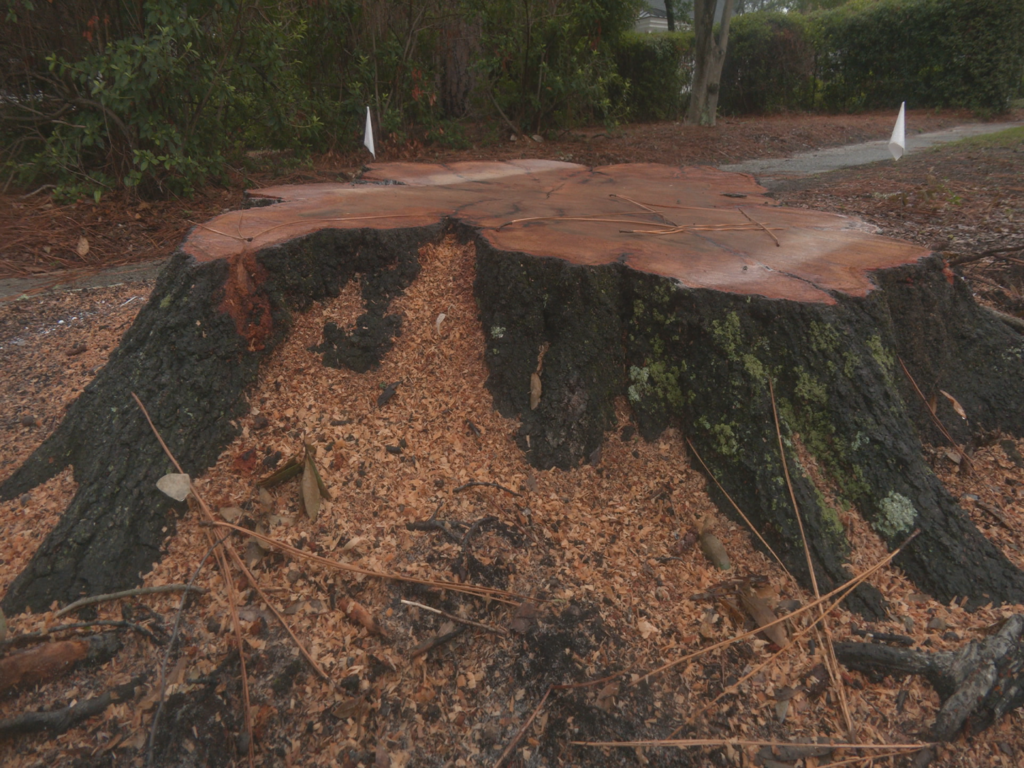
WILMINGTON, NC (WWAY) — The removal of three mature laurel oaks has sparked debate across Wilmington, with residents questioning both the decision to remove the trees and how the city communicated with the neighborhood before crews arrived.
Among those following the issue closely is Wilmington City Councilwoman Salette Andrews, who lives in the neighborhood and attended the community meeting the city held after concerns were raised.
“I actually went to the public meeting that was generated by this,” Andrews said.
Former Wilmington City Council member Luke Waddell has been one of the most vocal critics of the removals.
In a Facebook post, Waddell said he and other neighbors contacted city leaders and asked for an independent second opinion before the trees were removed.
“We asked for an independent second opinion before anything came down. The City said no,” Waddell wrote.
Waddell also criticized the city for what he described as a lack of communication before crews arrived.
The issue echoes another recent tree controversy in Wilmington. Earlier this year, city officials held a community meeting to explain the removal of several trees near South Third Street and First Presbyterian Church after similar concerns were raised by residents.
In the case of South Live Oak Parkway, the City of Wilmington said the removed trees were not southern live oaks, as many residents believed, but laurel oaks — a species that typically has a shorter lifespan and is more susceptible to internal decay.
According to the city, crews discovered extensive hidden damage, including large areas of decay in major branches, internal cavities up to two feet deep, and structural damage at branch unions, making the trees a public safety concern.
Dennis Baum, owner of Tree Nerds and an ISA Certified Arborist, said the city made the right decision.
“It’s at the end of its natural life. I’m not going to take my 101-year-old grandmother water skiing, right? This is a busy street,” said Baum. “It’s not the place for a tree that’s large, hazardous, and capable of failing without warning.”
Waddell also questioned why the Alliance for Cape Fear Trees, a nonprofit that advocates for Wilmington’s urban canopy and partners with the city on tree planting efforts, did not publicly oppose the removals.
Margee Herring, president of the Alliance for Cape Fear Trees, said the organization’s mission is to protect a healthy urban forest, which sometimes includes supporting the removal of unsafe trees.
“We can’t advocate for diseased trees. We can’t advocate for trees that have reached the end of their life. What we can advocate for is taking down trees that aren’t safe for our community,” Herring said.
Herring acknowledged the emotional impact of losing mature trees.
“It’s gut-wrenching,” she said. “This is less gut-wrenching than when we see wide streets, wide acres of land clear-cut.”
The City of Wilmington does plan on replanting the area with live oaks in the near future.