North Carolina honors the chimpanzee who helped pave the way to space
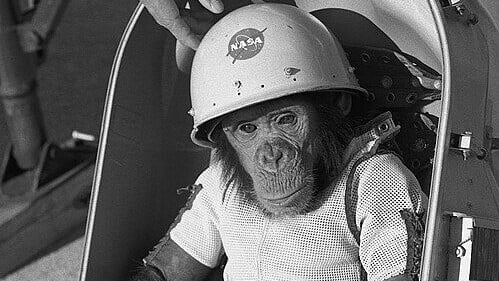
ASHEBORO, NC (WWAY) — A North Carolina resident with an out-of-this-world story will soon receive a permanent place in state history.
Ham the Astrochimp, the first hominid launched into space, will be honored with a North Carolina Highway Historical Marker near the entrance of the North Carolina Zoo in Asheboro.
The marker will be installed on July 14 at the roundabout near Zoo Connector (N.C. 159) and Zoo Parkway, recognizing Ham’s historic role in the U.S. space program and his connection to North Carolina.
Ham made history on Jan. 31, 1961, when he became the first hominid launched into space aboard the Mercury-Redstone 2 rocket as part of Project Mercury, NASA’s first human spaceflight program.
His name, “Ham,” came from the Holloman Aerospace Medical Center at Holloman Air Force Base in New Mexico, where he was trained for the mission.
Selected for intensive training in 1959, Ham was taught tasks designed to test whether learned behaviors could continue during the extreme conditions of spaceflight, including acceleration and weightlessness. His mission was used to help determine whether humans could safely operate spacecraft systems during space travel.
Ham’s flight lasted approximately 16 minutes, reaching an altitude of about 157 miles and speeds exceeding 5,800 miles per hour. Despite experiencing unexpected forces and a deviation from the planned trajectory, Ham successfully completed his assigned tasks, providing scientists with valuable data that helped pave the way for future human space missions.
The mission came during the height of the Space Race between the United States and the Soviet Union. Ham’s successful flight helped demonstrate America’s progress toward sending humans into space, occurring just months before astronaut Alan Shepard’s historic flight in May 1961.
Following his mission, Ham became a symbol of scientific achievement. He initially lived at the National Zoo in Washington, D.C., before retiring to the North Carolina Zoo in Asheboro, where he remained until his death in 1983.
Ham’s legacy continues beyond North Carolina. His remains were later interred at the International Space Hall of Fame in Alamogordo, New Mexico, honoring his contributions to the early days of space exploration.
The Highway Historical Marker Program is a partnership between the North Carolina Department of Natural and Cultural Resources and the North Carolina Department of Transportation. Officials say the new marker will help visitors learn about Ham’s groundbreaking mission and his place in both aerospace and North Carolina history.