What to know about Pakistan’s army chief and his role as mediator between Iran and the US
(AP) — A 15-second video put Pakistan’s powerful army chief back in the global spotlight.
Posted by Iranian Foreign Minister Abbas Araghchi, the video shows Field Marshal Asim Munir descending from a plane in military uniform and receiving a fraternal hug from him. The Pakistani official traveled to the epicenter of the conflict to try to ease tensions and arrange a second round of negotiations between Tehran and Washington.
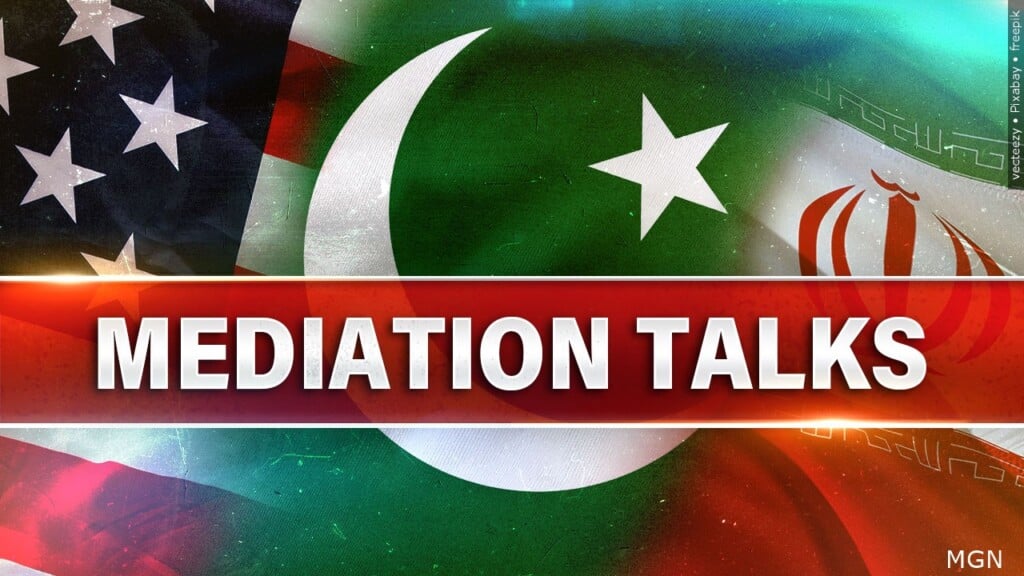
Pakistan has been acting as the main mediator between Iran and the United States, and much of the attention has been on Prime Minister Shehbaz Sharif and Foreign Minister Ishaq Dar, in part because they have been tweeting and issuing press releases about their efforts. But another figure has also been key to the process: the army chief.
Here are a few things to know about his role:
Behind the scenes, but a key player
Since Pakistan announced a few weeks ago that it was mediating between Iran and the U.S., Sharif has tasked Munir with maintaining behind-the-scenes contacts with American and Iranian political and military leaders in an effort to de-escalate the widening regional crisis, according to Pakistani officials.
There have been no specific details about what the army chief has been doing or whom he has met beyond publicly released images. However, the initial efforts appear to have had some effect, as Pakistan managed to convince U.S. and Iranian delegations to hold rare face-to-face talks in Islamabad last week.
The talks did not produce a formal agreement, but the communication channel has remained open, and Munir is considered to have played a vital supporting role, according to the officials, who spoke on condition of anonymity because they were not authorized to speak to the media.
Just a few days after the first round of talks ended, Pakistan kept reaching out to the parties and both sides agreed to explore a second round. In order to convince Iran, Munir flew to Tehran on Wednesday.
“Delighted to welcome Field Marshal Munir to Iran,” Araghchi posted on his X account alongside the video showing the Pakistani army chief.
According to Charles Lyons-Jones, a research fellow at the Lowy Institute, Sharif and Dar, the foreign minister, “may well appear to be prominent figures in the U.S.-Iran peace talks, but make no mistake, Asim Munir is the man taking the decisions.”
The most powerful military chief in Pakistan
Munir, a prominent figure inside and outside Pakistan, in December became the most powerful military person in the country when the government named him both the chief of army staff and defense forces. Months before, he was promoted to field marshal, only the second military officer in the country’s history to hold the title.
“Field Marshal Munir is easily the most powerful Pakistani leader since Pervez Musharraf, giving him complete authority over military appointments, civilian government decision-making and the military’s sprawling business empire,” Lyons-Jones said.
Born in 1968 to a lower-middle-class family, Munir grew up in Rawalpindi and joined the military in 1986 in Pakistan-administered Kashmir, a disputed region claimed by both Pakistan and India. He served in various parts of the country and spent time in Saudi Arabia as a colonel under a longstanding arrangement in which Pakistani forces help train Saudi troops. He learned Arabic and gained exposure to regional culture and politics, according to colleagues.
Munir later held several senior positions and is the only army chief to have headed both Military Intelligence and the Inter-Services Intelligence (ISI), the country’s premier intelligence agency.
Getting Trump’s attention
U.S. President Donald Trump has called Munir “my favorite field marshal,” underscoring the importance he places on him.
“The relationship Munir built with Trump has made Pakistan uniquely qualified to mediate peace talks between the United States and Iran,” Lyons-Jones said. “It is, indeed, the only country in the region that enjoys strong ties to Iran, the Gulf nations and the United States.”
Munir played a prominent role in last year’s four-day conflict between India and Pakistan, which raised of a nuclear confrontations, before Trump announced he helped facilitate a ceasefire. According to his associates, Munir played a central role in shaping Pakistan’s responses to regional crises.
When Iran carried out strikes inside Pakistan’s southwestern Balochistan province earlier this year, targeting what it described as rebel positions, officials say Munir supported a calibrated response that included Pakistan’s retaliatory strikes against militant hideouts across the border.
Similarly, following Indian strikes inside Pakistan last year, after an attack on tourists in Indian-administered Kashmir, Munir worked with senior military leadership on Pakistan’s response, according to Syed Mohammad Ali, a friend of Munir. Pakistani officials said they included coordinated use of air power, missiles and drones.
He adopted a similar approach along the border with Afghanistan, where the countries clashed over support for militant groups targeting Pakistan.
A man who takes on difficult assignments
Munir is regarded by those who know him as a figure who likes challenging assignments. He is also respected for his knowledge of the Quran, and is referred to as “hafiz,” or somebody who has memorized the holy book.
“He understands Islam, he understands the Quran, and he believes in what it teaches,” Ali said. “His concepts are very clear: he does what others fear to do.” Ali described Munir as a deliberate decision-maker. “He thinks many times before taking a decision, and once he decides, he pursues it with full dedication, leaving the outcome to God.”
His associates said that Munir’s visit to Tehran also reflects the Iranian leadership’s confidence in him, noting that senior Iranian officials — operating under heightened security concerns following U.S. and Israeli strikes — came out to receive him despite the risk of exposing their locations.