Swimming advisory issued for Wrightsville Beach after elevated bacteria levels detected
NEW HANOVER COUNTY, NC (WWAY) — State officials have issued a swimming advisory for a portion of Banks Channel in Wrightsville Beach after water testing found bacteria levels above state and federal recreational water quality standards.
The advisory applies to the sound-side public access at the corner of Waynick Boulevard and Sunset Avenue in Wrightsville Beach. According to the North Carolina Recreational Water Quality Program, samples collected over the past 30 days showed a running monthly average of 56 enterococci per 100 milliliters of water, exceeding the state and U.S. Environmental Protection Agency standard of 35 enterococci per 100 milliliters.
Erin Bryan-Millush with the N.C. Department of Environmental Quality’s Division of Marine Fisheries manages the state’s Recreational Water Quality Program. She said coastal states are required to monitor recreational waters and notify the public when bacteria levels exceed safe swimming standards.
“All coastal states are required to monitor recreational water quality waters and notify the public when waters exceed the safe swimming standard,” Bryan-Millush said. “We collect samples weekly throughout the summer swimming season, and when those samples exceed the standard, we are required to notify the public.”
Enterococci are bacteria commonly found in the intestines of warm-blooded animals. While the bacteria itself is not typically known to cause illness, it can indicate the possible presence of other disease-causing organisms.
Health officials say exposure to water with elevated bacteria levels may increase the risk of gastrointestinal illness, skin infections or other health issues, especially for people with weakened immune systems.
Bryan-Millush said the elevated bacteria levels appear to be connected to stormwater runoff following recent rainfall in the area.
“Unfortunately, during the summertime, we’ll have these sporadic rain events,” Bryan-Millush said. “Since Sunday, for the last four days, down in that area, we’ve had between two to four inches of rain. Those pre-treatment systems that the town has installed, when we have a large amount of rain come at one time, they overflow.”
Officials said the issue appears to be localized to the one testing site. Other nearby sampling locations have remained within safe swimming standards.
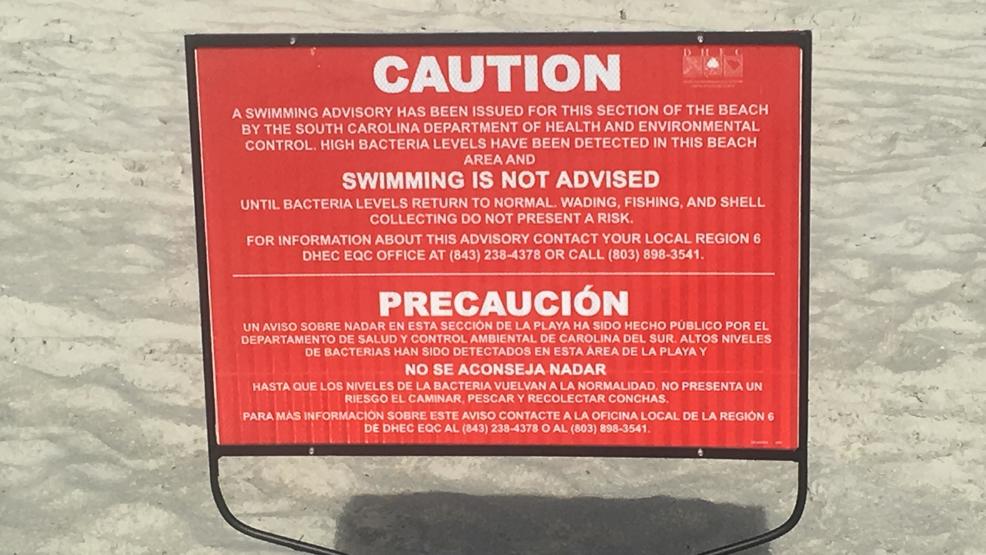
The advisory is not a beach closure and does not affect all of Banks Channel. The advisory applies only to waters within 200 feet of the posted warning sign at the Waynick Boulevard and Sunset Avenue public access.
The posted sign warns visitors that swimming in the area is not recommended because bacteria testing indicates contamination levels that may pose a health risk.
Bryan-Millush said the advisory is intended to give swimmers information so they can make informed decisions, rather than prohibit access to the water.
“We only have authority to advise the public. We do not close the beach,” Bryan-Millush said. “Our job is to give them an informed decision. If you go here, this is the risk you’re taking.”
State officials will continue testing the site and will remove the advisory once bacteria levels return below state standards. Officials said the advisory will remain in place until the site records two consecutive weekly samples that meet safety standards.
The N.C. Recreational Water Quality Program monitors 224 coastal sites, with most locations tested weekly from April through October. Testing continues on a reduced schedule during the rest of the year when fewer people are swimming.
Officials encourage beachgoers to check current water quality advisories before entering the water, especially after rainfall.
Bryan-Millush also reminded visitors that the advisory does not mean the entire Wrightsville Beach area is unsafe.
“North Carolina has a very pristine water quality history,” Bryan-Millush said. “This is a temporary issue that occurs after a rain event. The ocean side is fine — we sample there as well — and those areas are safe for swimming.”
Officials say swimmers should avoid sound-side waters near storm drains for 24 to 48 hours after rain events, as runoff can temporarily increase bacteria levels.